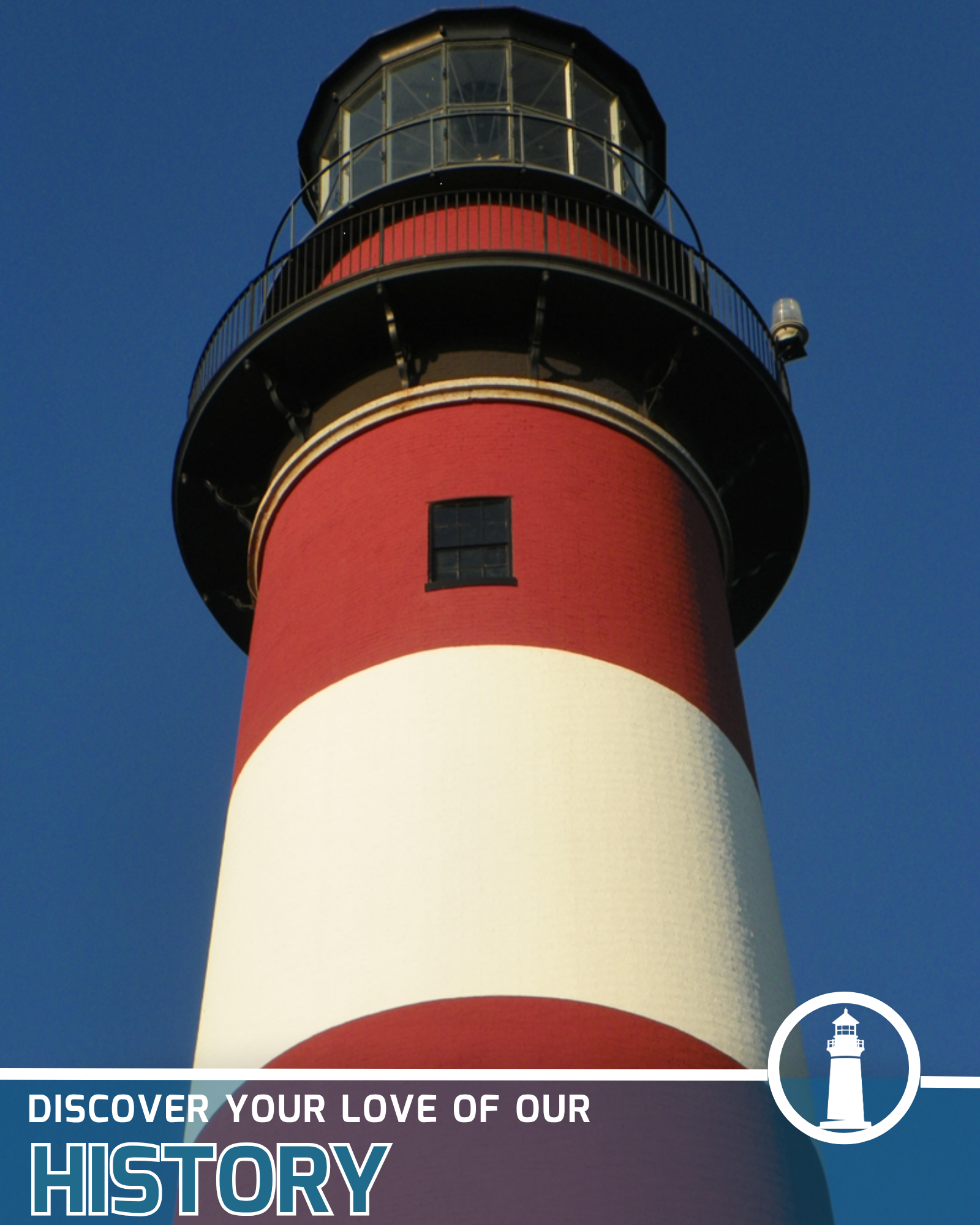
Discover your love of Chincoteague’s history
From an uninhabited hunting ground for the Native American Gingo-teague tribe, to a bucket list destination for over a million guests annually, Chincoteague has seen many changes over the centuries. We invite you to explore the interesting history of our unique little island with this two-day immersion into our storied past.
The Story of Chincoteague: A Brief History
The Gingo-Teague Tribe (for which the town is named) were a migratory group that used the island for hunting, fishing, and collection of valued shells. The earliest recorded encounter of European explorers having contact with the tribe was in 1650 when a group of sailors were marooned on an island on the Eastern Shore, possibly what we now know as Chincoteague. The Native Americans assisted the group of sailors in reaching another group of Europeans further south on the peninsula.
The first British settlers moved into the area later in the 17th century, by that time the native Gingo-Teague Tribe had moved farther North on the peninsula. Colonel Daniel Jenifer, a surveyor appointed by Governor Berkeley, was the first to claim land on the island in 1671. His son-in-law, Thomas Welburn, built a small house on the island and had a tenant, Robert Scott, live in the house for a year to “seat” the island.
By 1686, the island was considered abandoned and, despite protests from Welburn, the courts granted half the island to William Kendall and half to Major John Robins, with what is now Church Street as the dividing line. The first residents consisted of several tenants of Kendall and Robins as well as enslaved people.
Early Colonial life on Chincoteague was primitive, consisting of farming and raising livestock. The surrounding waters created natural barriers to contain horses, sheep, cattle, and pigs. The homes were one-story frame buildings with no windows or chimneys, simply smoke holes and sand floors. By 1776, there were 20 families and over 400 sheep living here and residents relied heavily on the mainland for goods and services.
In May 1776, the Virginia Convention ordered all livestock be removed from barrier islands to prevent British soldiers from raiding and stealing it for food. The people of Chincoteague submitted a petition, stating they should be allowed to keep and defend their livestock. This petition persuaded the Convention, allowing the people of Chincoteague and all the barrier islands, except one, were able to keep their animals.
Chincoteague Island may not have seen much action in the Revolutionary War, but the surrounding waters were very important to the American cause. In 1776, the British blockaded the mouth of the Chesapeake Bay in an attempt to cut off supply lines. The Chincoteague Bay became a very important route for supply ships from France and other neutral countries. Ships would make their way up the Chincoteague Bay, unload the cargo on the mainland across the water from Chincoteague. Goods were then carried across the peninsula and loaded back onto boats to travel up the Potomac River, bringing vital supplies to the American troops.
It is believed that four Chincoteague islanders fought in the war under General Washington. Two of whom, Chase and Smallwood, were at Yorktown when British General Cornwallis surrendered in October 1781. It is said they were close enough to see the Generals during the surrender. Legend has it that Chase was tasked with delivering a torn battle flag to George Washington’s home in Mt. Vernon at the end of the war, delaying his return home.
In 1821, the “Great September Gust” created a tidal wave that destroyed many of the island’s buildings. One man was carried 6 miles by the water from Chincoteague to the mainland. He managed to hold his grandson and keep him safe as he was swept away. Another man was found hanging by his belt from a tree limb 20 feet in the air. It is unlikely any buildings still remain that were built prior to that storm, which is why we know that the Captain Timothy Hill House is likely the oldest remaining building on the island. After the storm, the locals rebuilt and the community continued to grow.
The early 1800's brought a trading post, churches, a school, a doctor, and a population boom. With the growing population, land for farms became less available, and seafood became the main occupation for many inhabitants; an influx of waterman and oysterman began.
The first lighthouse was built on Assateague in 1833. It was only 45 feet tall and candlelit, so it was not very effective.
By the later 1800’s a “Downtown” area had begun to develop on Main Street between what is now Cropper Street and Church Street and the population continued to grow. The island had a Post Office, a customs office, and Assateague Island had a Life Saving Station, a predecessor to the modern Coast Guard. These institutions of the Federal Government brought a steady income to the employees and contributed to the growth and stability of the island community.
In 1861, the island voted 134 to 2 not to secede from the Union. The majority of oysters being sold from the island were going to Northern cities. As such the loyalty of the islanders was solidly in favor of the Union. The town played a role in the Civil War when the Battle of Cockle Creek was fought in Chincoteague Bay in 1861. A successionist schooner was sunk by the USS Louisiana.
Over 100 men from the island joined the Loyal Eastern Virginia Volunteers. One woman, Mary Thornton Young, was unhappy to hear her husband had enlisted and she too joined the war effort by traveling with and cooking for the regiment. After the war, another influx of residents began and in 1866 the island had 110 houses.
The railroad arrived in 1876, ending 5 miles across the Chincoteague Bay in Franklin City, which is now a part of Greenbackville, making Chincoteague Island easily accessible for the first time. Ferry boats brought people and goods across the water to the island. The Atlantic Hotel was built bringing tourists and sportsmen. The oyster industry was booming and this little island was flourishing. By 1911, Chincoteague was considered a progressive, modern, and thriving community.
Two major fires in 1920 and 1924 destroyed much of the downtown area and prompted the creation of the Chincoteague Volunteer Fire Company (CVFC) in 1925. To raise money for new equipment, the CVFC took over the annual Pony Penning on Assateague Island and established the Annual Fireman’s Carnival. These fires shaped the current Historic Main Street we know today.
Meanwhile, work was being done to permanently connect Chincoteague to the mainland as the causeway was created and opened in 1922, making the island more accessible to the growing tourism industry.
WW2 brought the presence of the Army and Navy to Chincoteague and grew the influence and importance of the US Coast Guard, establishing the base where it stands today.
A burst of popularity came to the island after the 1947 publishing of the beloved book Misty of Chincoteague by Marguerite Henry with illustrations by Wesley Dennis and again in 1961 with the premier of the film, Misty.
Along with the seafood industry and sportsmen tourism, chicken farming was a major part of the island for many years. The Ash Wednesday storm of 1962 put the town underwater, destroying many structures and devastating the poultry industry. It never recovered, though signs of that history can be seen in old chicken houses and names like Chicken City Road. Despite this tragedy, a new life was beginning for the island, with the completion of the bridge to Assateague Island that same year. With easy access to the pristine beaches and natural beauty of the Chincoteague National Wildlife Refuge, created in 1943, tourism in Chincoteague boomed and has continued to grow since then.
The town’s population is now approximately 3,000 and life on the island has changed in many ways. The primary economy has evolved over the years from farming to seafood and now, to tourism. This tour guide will help show you Chincoteague’s rich history and provide a glimpse into the way life once was on this historic and unique island.
Chincoteague is for History Lovers Itinerary
Your first step is to book a stay in one of the many historic Bed & Breakfasts, Campgrounds, Rental Homes, Hotels or Motels that are here on the island.
Day 1 – Enjoy breakfast at your hotel, B&B, rental house or campground or in one of the restaurants serving hot, full meals to get you started.
Swing by the Chincoteague Chamber of Commerce to get maps, guides, information, and helpful hints from the friendly staff.
Visit the Museum of Chincoteague Island and wander through the history of the island. With annually updated exhibits, the Museum is the perfect place to learn and engage with the rich history and traditions of Chincoteague. Various exhibits showcase the first-order Fresnel lens from the Assateague Lighthouse, decoy carving, our famous pony, Misty, the oyster industry, farming, our volunteer fire company, the Ash Wednesday Storm, and more. Be sure to purchase a combo ticket for your day 2 visit to the Beebe Ranch.
Head to the Herbert H. Bateman Visitor Center on Assateague Island to learn about the history of the Chincoteague National Wildlife Refuge established in 1943 and the Assateague National Seashore established in 1965. The Bateman Center has a variety of interactive displays and an abundance of information about Assateague Island.
Take a Refuge Trek Tour. This small bus tour is a program owned and operated by Friends of Chincoteague National Wildlife Refuge. It leaves from the Bateman Center and takes visitors up the seven-mile service road that is not open to the public. Learn information about the history of the Refuge while spotting some of the amazing wildlife that lives there. You might even see some of the famous wild ponies! These tours are available seasonally.
Now that you know all about Assateague Island, visit the historic Assateague Lighthouse built in 1867. While you can visit the lighthouse year-round, seasonally the building opens to climb. Learn about the lighthouse's history from a docent and climb the 175-steps up the circular staircase to the top for an incredible view of Assateague, Chincoteague, and Wallops Islands as well as portions of coastal Virginia and Maryland.
Next, enjoy a walk on the beach to see the old Coast Guard Life Saving Station, built in 1922 at the southern end of Assateague Island. Ask the Bateman Center about seasonal closures of this area for the protection of our piping plovers.
Experience the historic seafood industry of Chincoteague. Dine at one of our fine restaurants feasting on fresh from the waters, clams, world-famous Chincoteague Oysters, and the 'catch of the day' which could be red drum, flounder, rockfish, or tuna.
Complete your day with an ice cream treat at one of our amazing ice cream parlors.
Day 2 – Grab a cup of coffee and a pastry from JavaHorse Coffee or Mister Whippy and stroll the Historic Downtown area. Use the Historic Chincotaegue Island Self-Guided Tour to spot some interesting landmarks. You can even follow “Misty’s Trail” with locations that are significant to Misty marked in the guide.
Do some shopping in the businesses that occupy the historic buildings on Main Street, many originating in the 1920s, and throughout the island. Check out our local gift shops and bookstores to dig deeper into the mysteries of our small island.
Take a guided tour of the Historic Downtown area with Chincoteague Step Through Time Tours. An expert on island history will give you a fantastic look back at Chincoteague from the early settlers to today. Lots of great stories about the people and ponies that have made Chincoteague a special place to live.
For lunch, picnic at one of our beautiful waterfront parks with a boxed lunch from one of our many eateries or enjoy indoor dining at one of our restaurants.
Visit the Beebe Ranch to learn about Misty of Chincoteague, the history of raising ponies on the island, and meet descendants of Misty herself.
Next, head to the Captain Timothy Hill House, the oldest known building on the island; circa 1800. It had gone unnoticed for years until new owners uncovered its history and restored it to its original condition. Discover the early sailing ships carved into the exterior logs on all sides of the house any time of year or take a tour with a docent during their summer hours.
Take a boat cruise around Chincoteague Island while learning more about Chincoteague and Assateague Island history from knowledgeable boat captains. Locals have made their living off the waters of Chincoteague and Assateague Channels and the Atlantic Ocean for generations. The seafood industry (oystering and clamming) was the prime source of income for many islanders until the late 1960s. You will pass by active aqua farms as you enjoy your peaceful time on the water. Some of our boat tours even offer hands-on aqua farm experiences, so you can live the island’s history.
Catch a movie at the historic Island Theatre. The theatre opened in 1947 and was designed in a late art deco style featuring a vitrolite glass and yellow brick facade. It was the first air conditioned theater on Virginia's eastern shore.
Day 3
Extend your stay and head off island to explore the Eastern Shore's museums and antique malls that are rich in history.
Check our events calendar for other special lectures, programs and events happening throughout the year.
Informational Credits:
Assateague and Chincoteague As I Remember Them by Lillian Mears Rew
Once Upon An Island by Kirk Mariner
Mrs. Victoria Pruitt